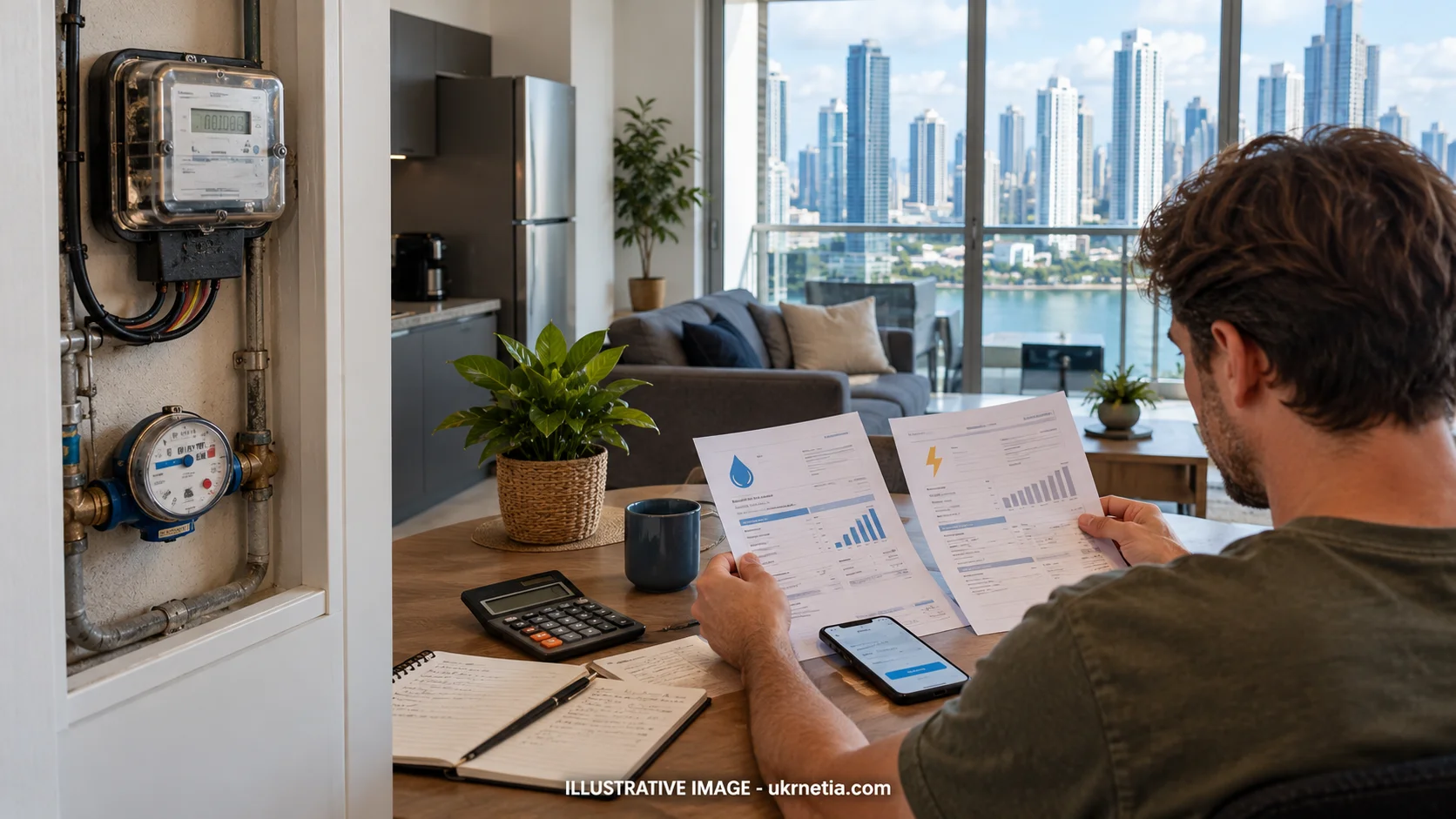
Who Pays for Water and Electricity in a Panama Rental?

When renting an apartment or house in Panama, the responsibility for paying water and electricity depends on the rental agreement, the property’s utility meters, and the way the bills are issued. Electricity is often paid separately by the tenant, while water may be included in the rent or charged separately. Neither arrangement should be assumed without confirmation. Before signing a lease, tenants should establish exactly which bills they must pay, how charges are calculated, and who is responsible for outstanding balances.
For foreigners moving to Panama City, understanding utility payments is an important part of budgeting for accommodation. An apartment advertised at an attractive monthly price may become significantly more expensive once electricity, water, internet, and other recurring expenses are added.
The process can also be confusing when the electricity or water account remains in the landlord’s name, several apartments share a meter, or the rental price includes some utilities but not others.
This guide explains how water and electricity payments work in Panama rentals, what tenants should check before moving in, and how to avoid disputes over utility bills.
Who Pays for Utilities in a Panama Rental?
There is no single arrangement that applies to every rental property in Panama. The lease and the property’s billing arrangements are central to determining who is expected to pay.
Tenants may encounter several common situations:
- The tenant pays directly: The tenant receives and pays the electricity or water bill, where the account and service arrangements allow this.
- The landlord pays the provider: The landlord remains responsible for the utility account and includes the cost in the rental price.
- The tenant reimburses the landlord: The landlord receives the bill and the tenant pays the agreed amount after receiving a copy.
- Utilities are included up to a limit: The rent covers specified services or a defined consumption allowance, while additional consumption may be charged separately.
- The property has shared meters: The landlord or property manager allocates the bill according to an agreed method.
These arrangements are not interchangeable. For example, a lease might include water but require the tenant to pay electricity separately. Another property might advertise an all-inclusive monthly price but impose a limit on air-conditioning consumption.
The most important step is to obtain a written explanation of the arrangement before paying a deposit or signing a contract.
What Does Panamanian Rental Law Say?
Panama’s rental framework includes Law 93 of October 4, 1973, which addresses residential and other rental arrangements and establishes a legal framework for rental contracts and the rights and duties of landlords and tenants. The official legal record is available through the Panamanian government’s Infojurídica legal database.
However, the existence of rental legislation does not mean that every water or electricity payment arrangement is identical. The applicable rules may depend on the type of lease, the property, the contract terms, and other relevant regulations.
The Ministry of Housing and Land Use Planning, known as MIVIOT, provides information and guidance on rental matters. Its official guidance discusses landlords’ and tenants’ rights and obligations, including requirements concerning the condition and maintenance of rental housing.
Tenants should therefore read the utility clauses in their lease rather than relying on a general assumption about what landlords normally pay. If a clause is unclear or appears inconsistent with applicable law, seek clarification from MIVIOT or a qualified Panamanian legal professional.
Who Pays for Water in a Panama Rental?
Water payments can be handled differently depending on the building, the account arrangement, and the terms agreed between the landlord and tenant.
In some rentals, water is included in the monthly rent. In others, the tenant pays the bill directly or reimburses the landlord. In apartment buildings with shared water meters, charges may be allocated among several units.
When Water Is Included in the Rent
Some landlords include water in the advertised rental price, particularly when the property’s billing arrangements make it convenient to pay a single building-level bill.
For tenants, this can make monthly budgeting easier because they do not have to manage a separate water payment.
However, the phrase “water included” should be clarified in the contract. Ask whether it covers the full water charge, whether sewerage charges are included where applicable, and whether any usage limits or additional charges apply.
For example, a furnished apartment may be advertised at $1,000 per month with water included but electricity billed separately. A tenant should not interpret that offer as meaning that every utility is covered.
Before signing, confirm:
- Whether water is fully included in the monthly rent.
- Whether sewerage or other associated charges are covered.
- Whether the landlord can charge extra for unusually high consumption.
- Whether the arrangement changes if the tenancy is extended.
- Whether water charges are included in a building maintenance fee or handled separately.
The answers should be recorded in the lease or a written addendum.
When the Tenant Pays for Water Separately
If the tenant is responsible for water, the contract should explain how the payment is made.
There are two main possibilities.
Individual water meter: The property has its own meter, making it easier to associate consumption with the rented unit. The tenant should confirm how the bill is obtained and whether the account can be placed in the tenant’s name.
Shared water meter: Several apartments use a common meter, and the landlord or property manager allocates the total bill. In this case, the tenant should ask how the amount is calculated.
A shared bill might be divided equally among units, allocated according to an agreed formula, or handled through building charges. The method should not be left to guesswork.
If a landlord asks for a separate water payment, request a copy of the actual bill and a clear explanation of the tenant’s share. This is particularly important when several households occupy the same property.
Does Water Always Come Included in Panama City Apartments?
No. Tenants should not assume that water is automatically included just because an apartment is in a modern building or is advertised as furnished.
The arrangement depends on the individual property and lease. A landlord may cover water as part of the rental price, while another may pass the cost to the tenant.
The best approach is to treat water as a separate line in the rental budget until the landlord confirms otherwise in writing.
Who Pays for Electricity in a Panama Rental?
Electricity is a particularly important expense to investigate because air conditioning can substantially affect consumption in Panama’s tropical climate.
In many rental arrangements, the tenant pays electricity separately. This may involve paying the utility provider directly or reimbursing the landlord if the account remains in the landlord’s name.
Electricity may also be included in furnished or short-term rentals, sometimes subject to a consumption allowance.
When the Tenant Pays the Electricity Bill Directly
If the tenant is responsible for the electricity account, establish which company serves the property and how the account will be managed.
Electricity distribution in Panama is handled by different companies depending on the service area. ENSA and Naturgy are among the providers relevant to Panama’s electricity market, so the correct provider should be confirmed for the particular address.
Before moving in, ask the landlord or agent for:
- The electricity provider’s name.
- The account or meter reference, where appropriate.
- Confirmation that the account is active.
- Information about any outstanding balance.
- The procedure for transferring or registering the account, if applicable.
- Instructions for obtaining bills and making payments.
Do not assume that an account can automatically be transferred to a foreign tenant without additional documentation. Confirm the provider’s requirements before signing the lease.
It is also useful to photograph the meter reading at the beginning of the tenancy, where access is permitted. This creates a record of the starting point if the first bill covers a period that began before the tenant moved in.
When the Electricity Account Remains in the Landlord’s Name
Sometimes the landlord retains the electricity account and asks the tenant to reimburse the bill.
This arrangement can work, but it requires transparency. The tenant should receive a copy of the original utility invoice and understand the payment deadline.
The lease should specify:
- That the tenant is responsible for the agreed electricity costs.
- How the landlord will provide the bill.
- When reimbursement is due.
- Whether the tenant pays the actual bill or an agreed allowance.
- How billing periods that overlap the beginning or end of the tenancy are handled.
For example, if the landlord forwards an electricity bill for $85, the tenant should be able to verify the billing period and amount rather than being asked to pay an unexplained figure.
If the bill includes consumption from before the tenancy began, the parties should agree on a fair allocation based on the available readings and billing information.
When Electricity Is Included in the Rent
Some rentals include electricity in the advertised monthly price. This is more likely to be relevant in certain furnished, serviced, or short-term arrangements, but it should always be verified.
An all-inclusive price can be convenient for foreigners who want predictable expenses. However, landlords may establish a monthly consumption limit or charge extra if usage exceeds an agreed allowance.
Suppose a lease states that electricity is included up to a specified monthly amount. The contract should explain what happens when the bill exceeds that amount, how the excess is calculated, and what evidence the landlord must provide.
Without these details, disputes can arise when the tenant uses air conditioning more frequently than the landlord expected.
Why Air Conditioning Can Make a Big Difference
Electricity consumption in Panama depends on the property and the tenant’s habits. Air conditioning can be a major factor, particularly in apartments where several rooms are cooled throughout the day.
A tenant who works remotely and keeps the air conditioning running for many hours may consume considerably more electricity than someone who spends most of the day outside.
Factors affecting consumption include:
- The number and size of air-conditioning units.
- How many hours the units operate.
- The temperature settings.
- The apartment’s size and exposure to sunlight.
- Insulation and building design.
- The efficiency and condition of the equipment.
- Other appliances, including water heaters, dryers, and electric cooking equipment.
How to Estimate Air-Conditioning Consumption
You can estimate the energy consumed by an appliance using this formula:
Energy consumption (kWh) = Power (kW) × Operating hours
For example, suppose an appliance has a measured electrical input of 1.0 kW and operates for six hours per day.
- Daily consumption: 1.0 kW × 6 hours = 6 kWh.
- Consumption over 30 days: 6 kWh × 30 = 180 kWh.
This is an illustrative calculation, not a prediction for every air-conditioning unit. Actual consumption depends on the equipment’s input power, operating conditions, and how frequently the compressor runs.
To estimate the monetary cost, multiply the additional consumption by the applicable electricity rate and account for any other relevant bill components. Check the current tariff and the property’s actual billing category rather than relying on a generic price per kilowatt-hour.
The Autoridad Nacional de los Servicios Públicos (ASEP) publishes information about electricity regulation and customer complaints. In July 2026, the regulator reported action requiring electricity distributors to address service problems, including concerns involving high consumption and billing.
If the landlord includes electricity in the rent, ask whether the allowance is sufficient for your expected air-conditioning use. If you work from home, say so before signing.
What If the Apartment Has Shared Water or Electricity Meters?
Shared meters require particular attention because the tenant may not be able to identify their individual consumption from the main bill.
This arrangement can be found in some multi-unit properties or buildings where utilities are not separately metered for every apartment.
A landlord may divide the bill among tenants or use another agreed method. The important issue is whether the calculation is clear, consistent, and supported by the lease.
Before agreeing to a shared-meter arrangement, ask:
- How many apartments or units share the meter?
- How is each tenant’s share calculated?
- Is the bill divided equally or according to another formula?
- Can the tenant see the original bill?
- What happens if one unit is vacant?
- How are unusually high charges investigated?
- Does the landlord charge an additional administrative fee?
If a landlord divides a $120 bill equally among three apartments, each apartment’s share would be $40 under that specific arrangement. But equal division is not necessarily appropriate in every building, particularly if units differ significantly in size or occupancy.
The allocation method should be agreed upon in writing. Tenants should be cautious about clauses that allow the landlord to set utility charges without explaining the calculation or providing supporting documentation.
What If the Landlord Charges More Than the Actual Bill?
If a landlord asks for a utility payment that appears higher than the original invoice, do not immediately assume that the charge is fraudulent. First establish what the amount covers.
Possible explanations include a different billing period, an agreed allocation of shared consumption, a separately documented charge, or a calculation error.
Follow these steps:
1. Request the original bill. Ask for a copy showing the provider, billing period, account reference, and total amount.
2. Check the dates. Make sure the bill corresponds to the period covered by your tenancy.
3. Ask for the calculation. If several units share a meter, request the formula used to determine your portion.
4. Compare the charge with the lease. Check whether the agreement permits an additional fee or defines an allowance.
5. Keep written records. Save bills, receipts, payment confirmations, and messages with the landlord.
6. Seek assistance if necessary. If the dispute cannot be resolved, consider asking MIVIOT for guidance on the rental-contract issue or contacting ASEP about a regulated utility billing complaint, as appropriate.
ASEP provides information about customer complaints involving electricity, drinking water, and sewerage services. Its official website includes information on user assistance and complaint statistics.
The appropriate route depends on the nature of the problem. A dispute over how a landlord allocates a bill under a lease is not necessarily the same as a complaint about the utility provider’s invoice.
What If the Electricity Bill Suddenly Increases?
An unexpectedly high bill can be concerning, especially when a tenant has only recently moved into a property.
Before disputing the amount, check whether the increase can be explained by a change in usage or billing circumstances.
Common possibilities include:
- More frequent air-conditioning use.
- A change in the billing period.
- Increased occupancy.
- A faulty appliance.
- A leaking or inefficient hot-water system.
- Incorrect meter readings.
- Shared consumption that was not previously explained.
- An error in the utility account or invoice.
Compare the bill with previous months and check the meter reading, if accessible. If the reading appears inconsistent, document it and contact the provider through its official customer service channels.
If you suspect that a defective appliance or building system is responsible, notify the landlord in writing. Keep a copy of the communication and agree on the next steps before authorizing significant repairs.
The person responsible for paying electricity is not automatically responsible for every defect in the property’s electrical installation or appliances. Responsibility for repairs depends on the cause, the lease, and applicable law.
Who Pays for Water Leaks and Electrical Repairs?
Paying for utility consumption is different from paying to repair the systems that supply a property.
For example, a tenant may be responsible for the water bill while the landlord is responsible for addressing a defective pipe, depending on the circumstances and the applicable contractual and legal requirements.
Similarly, a tenant may pay the electricity bill without being responsible for repairing defective wiring or replacing equipment that failed through ordinary wear and tear.
Panama’s rental framework includes obligations concerning the condition and maintenance of residential premises. MIVIOT has highlighted the requirements of Article 8 of Law 93 concerning hygiene, health, and safety, as well as Article 28 concerning the landlord’s responsibilities for maintaining the rented property and common areas.
These provisions should not be treated as a blanket rule assigning every repair to the landlord. The cause of the problem and the applicable legal requirements matter.
When a problem arises:
- Notify the landlord or property manager promptly.
- Photograph visible damage or leaks.
- Keep copies of utility bills and repair requests.
- Avoid making major alterations without permission.
- Ask who will arrange and pay for the repair.
- Seek professional advice if responsibility remains disputed.
For water leaks, prompt reporting is especially important because an unresolved leak can increase consumption and damage the property.
What Should Tenants Check Before Moving In?
Before accepting the keys, establish a clear record of the apartment’s condition and utility arrangements.
Use this checklist:
-
Confirm in writing whether water is included in the rent.
-
Confirm in writing whether electricity is included.
-
Check whether the rent includes sewerage or related charges.
-
Identify the utility providers serving the property.
-
Establish whether meters are individual or shared.
-
Request recent utility bills where possible.
-
Check for outstanding balances and agree who is responsible for them.
-
Record accessible meter readings on the move-in date.
-
Photograph visible leaks or damage.
-
Test taps, toilets, lights, electrical outlets, and supplied appliances.
-
Confirm any utility allowances or consumption caps.
-
Establish how bills will be delivered and paid.
-
Keep a signed copy of the lease and any written utility arrangements.
This process is useful even when the apartment is furnished or the landlord appears trustworthy. Clear records reduce the risk of disagreements later.
What Happens to Utility Bills When You Move Out?
Moving out creates another potential source of disputes because a final bill may arrive after the tenant has returned the keys.
Before leaving, agree on how the final water and electricity charges will be calculated.
If the property has individual meters, record the readings and date. If the account is in the landlord’s name, request the final invoice when it becomes available.
If the meter is shared, ask the landlord to explain how the final amount will be allocated and which billing period it covers.
You should also confirm:
- Whether utility accounts need to be closed or transferred.
- How outstanding verified bills will be paid.
- Whether any amount will be charged after the tenancy ends.
- How bills covering periods before or after the tenancy will be allocated.
- Whether the landlord intends to deduct any amount from the security deposit and the basis for that deduction.
Do not assume that every utility charge can automatically be deducted from a deposit. Any proposed deduction should be assessed against the lease and applicable law, with supporting documentation.
Keep receipts and written confirmation of the final payments. This provides evidence if a dispute arises after you have left the property.
Water and Electricity in Different Types of Panama Rentals
Utility arrangements can differ according to the type of property and the length of the tenancy.
| Rental type | Water | Electricity |
|---|---|---|
| Unfurnished long-term apartment | May be included or billed separately | Often billed separately, subject to the lease |
| Furnished long-term apartment | May be included or billed separately | May be separate or subject to an allowance |
| Short-term furnished rental | May be included in the advertised price | May be included, sometimes with consumption limits |
| Serviced apartment | Often bundled with other services, depending on the offer | Often bundled or subject to stated terms |
| House rented directly from an owner | Depends on the account and contract | Depends on the account and contract |
| Apartment with shared meters | May be allocated by an agreed formula | May be allocated by an agreed formula |
These are general descriptions of possible arrangements, not guaranteed rules for every property.
Always examine the specific listing and lease. An apartment advertised as “all utilities included” should still be checked for consumption limits, excluded services, and any additional charges.
Sample Utility Clauses to Look for in a Lease
The following examples illustrate how rental agreements may describe utility payments. They are educational examples, not official Panamanian legal wording.
Example 1: Tenant Pays Both Utilities Directly
“The tenant is responsible for water and electricity consumption during the tenancy and shall pay the applicable utility providers according to their invoices.”
What to check: Confirm whether the accounts can be registered in your name, whether meters are individual, and whether the landlord has any outstanding balances that need to be resolved before you move in.
Example 2: Water Included, Electricity Paid Separately
“The monthly rent includes water service. Electricity consumption is the tenant’s responsibility and shall be paid separately.”
What to check: Confirm whether sewerage charges are included, whether any water usage limits apply, and how electricity bills will be provided.
Example 3: Electricity Included up to a Monthly Allowance
“The monthly rent includes electricity consumption up to the allowance specified in this agreement. Any excess shall be calculated according to the utility invoice.”
What to check: The contract should define the allowance, the billing period, the method for calculating excess consumption, and the documentation the landlord must provide.
Example 4: Utilities Reimbursed Through the Landlord
“The tenant shall reimburse the landlord for the tenant’s agreed share of utility bills upon receipt of supporting invoices.”
What to check: Make sure the agreement defines the tenant’s share, payment deadline, allocation formula for shared meters, and how bills spanning different tenancy periods are handled.
These examples show why specific wording matters. A clause that simply says “utilities are the tenant’s responsibility” may leave unanswered questions about shared meters, billing periods, or account administration.
Frequently Asked Questions
Is water usually included in rent in Panama?
Water may be included in some rentals and billed separately in others. The answer depends on the property and the lease. Ask the landlord to confirm the arrangement in writing.
Does a tenant normally pay the electricity bill in Panama?
Many rental agreements require tenants to pay electricity separately, but this is not universal. Furnished and short-term rentals may include electricity or impose a consumption allowance.
Can the landlord keep the electricity account in their own name?
An account may remain in the landlord’s name while the tenant reimburses the agreed charges. Confirm the arrangement, request copies of invoices, and verify the provider’s account requirements.
Can a landlord charge extra for air-conditioning use?
A lease may establish a utility allowance or other agreed billing arrangement. Check whether excess consumption is addressed in the contract and request supporting invoices for additional charges.
Who pays for water if several apartments share one meter?
The answer depends on the lease and the agreed allocation method. Ask how the bill is divided and request a transparent calculation rather than accepting an unexplained amount.
Should I request previous electricity bills before renting?
Yes, where possible. Recent bills can help you understand the property’s consumption patterns, particularly if it has multiple air-conditioning units. They do not guarantee that your future bills will be the same.
Can I refuse to pay a utility charge I cannot verify?
Do not assume that an unexplained charge is automatically invalid or that you can safely ignore it. Request the original bill and the calculation, review the lease, and seek qualified advice if the dispute remains unresolved.
Who pays for a leaking pipe or defective electrical installation?
Responsibility depends on the cause of the problem, the lease, and applicable law. Report defects promptly and document the issue rather than assuming that the person who pays the utility bill must also pay for repairs.
What should I do if the electricity bill suddenly increases?
Compare the billing period and meter reading, review your usage, and contact the provider if the invoice appears incorrect. Notify the landlord if a property defect or shared-meter arrangement may be involved.
Which Panamanian authority can help with rental questions?
MIVIOT provides guidance on rental matters. The official Panama Digital service for rental guidance identifies the relevant government service and its legal basis.
For complaints involving regulated electricity, water, or sewerage services, ASEP may also be relevant. The appropriate authority depends on whether the problem concerns the rental contract, the landlord’s allocation of costs, or the utility provider’s service or billing.
How to Avoid Utility Payment Disputes in a Panama Rental
The simplest way to avoid confusion is to establish responsibility for water and electricity before signing the lease. Confirm whether each utility is included in the rent, paid directly by the tenant, or reimbursed through the landlord.
If the property has shared meters, insist on a transparent allocation method. If the landlord retains the utility accounts, agree on how invoices will be shared and how payments will be documented.
Record meter readings when moving in and out, keep copies of bills, and report suspected leaks or electrical problems promptly.
Most importantly, calculate your housing budget using the full monthly cost rather than the advertised rent alone. A clear agreement about water and electricity can help you avoid unexpected expenses and make renting in Panama much more predictable.